CGC2026 | Francisco Hortigüela Martos:人工智能价值链——从人才到超级计算
2026-11-02
以下文章来源于微信公众号——全球计算联盟GCC

GCC NEWS
【中国·深圳,2026年10月21日】 由全球计算联盟(GCC)主办的2026全球计算大会(CGC2026)顺利举办。大会以 “兆瓦筑新基,超节点释放澎湃算力” 为主题,聚焦兆瓦级智算基础设施建设、超节点技术体系构建,集中发布多项重磅产业成果,搭建起全球计算产业开放对话、协同创新的重要平台。大会期间,西班牙科技和信息技术协会(AMETIC)主席Francisco Hortigüela Martos带来主题演讲《The AI Value Chain. From Talent to Supercomputing》。以下为速记内容,并经AI辅助整理编辑,仅供参考。完整版演讲视频已上线,欢迎观看。
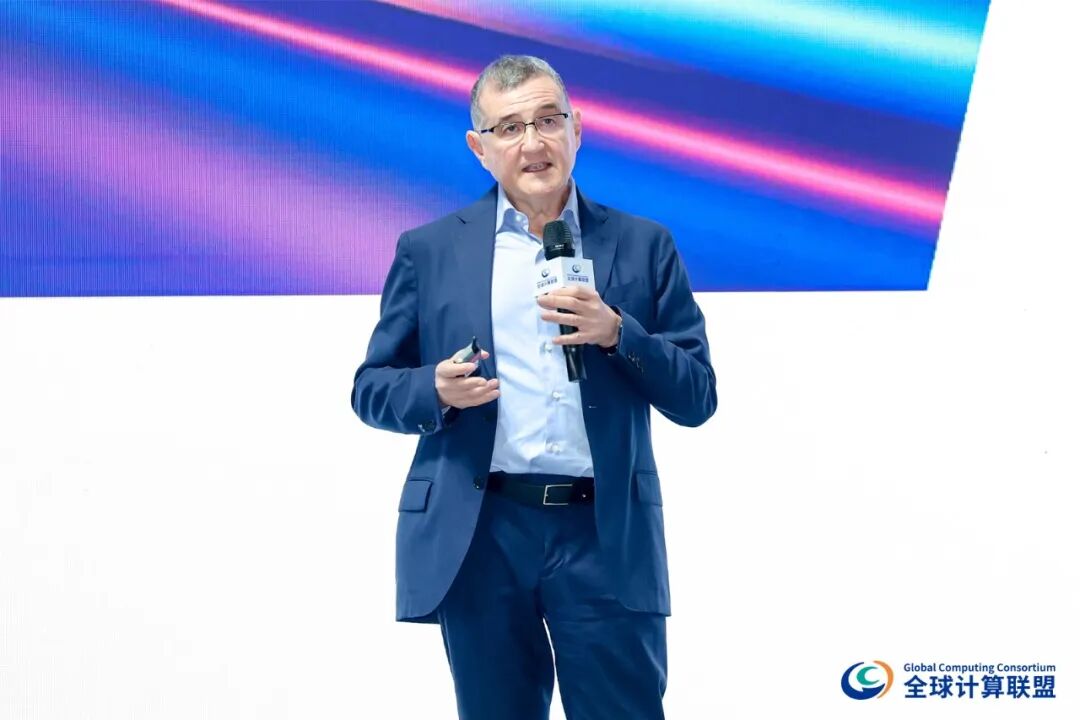
图:西班牙科技和信息技术协会(AMETIC)主席
Francisco Hortigüela Martos作主题演讲
Good morning, everybody. Thank you very much to the Global Computing Consortium for inviting me to participate in this great conference. It is a pleasure for me, and for AMETIC, to be here today.
Let me start by introducing AMETIC, because I guess most of you don’t know us. AMETIC is the national trade association for the digital industry in Spain, and we represent the whole digital ecosystem. Our members are not only big companies — companies you can imagine, like Huawei, Google, Facebook, Microsoft — but also small and medium enterprises. We have companies from the offer side, but also companies from the demand side. And on top of that, academia and universities are also members of AMETIC. This makes our meetings and discussions very complete, because we are talking about the ecosystem — not only from the industrial point of view, but from the whole ecosystem.
The digital industry in Spain represents a turnover of 146 billion euros a year. We employ more than 1.4 million people in our sector, and we have more than 36,000 companies in Spain working in the digital ecosystem. On top of that, we are one of the biggest investors in research and development: 20% of the total R&D in Spain is made by the digital sector. And I’m very proud to say that Spain is leading in digital technology evolution in Europe — according to the EU ranking, we are No. 1 when compared to the biggest economies like Italy, France and Germany.
We are also collaborating with other industrial associations. Here in Spain you have CEOE, which is the association of associations — all industries are reflected in CEOE: construction, hospitality, energy, all kinds of industries. We are members of its executive committee and its board, and we are also founders of the standardization office in Spain. On top of that, we are very proud to be a member of DIGITALEUROPE and ALETI. DIGITALEUROPE is the European association of associations in the digital industry, and ALETI is the association for Latin America. As you may know, Spain is a bridge between Europe and Latin America. If we look at these regions: in the case of Latin America, including Spain, we are talking about a population of around 500 million people and about 6% of world GDP. In the case of Europe, we are talking about 447 million people and 18% of world GDP.
As I said, Spain is leading in connectivity, in talent and in energy. This is one of the reasons why we are attracting a lot of computing power and development to Spain, and the pipeline we have for new AI data centers is very good. Energy in Spain is very competitive because we have one of the highest ratios of renewable energy, and the cost of energy is therefore very, very competitive. Our connectivity is also one of the highest in Europe — and talent, which I will talk about later. AMETIC is a positive, proactive association. Of course, we work with governments and with industry to develop the best possible regulation, but we also propose our own projects for Spain’s digital industry — projects with a real impact on competitiveness, on the economy, on industry, and of course on society. In March this year, we published the AMETIC Development Agenda for 2026–2030. This agenda contains 218 different proposals that we are now discussing with the government and also with the political parties, because, as you may know, we will have elections by the end of the year — and we want this digital agenda to become part of the government’s policies.
Coming back to the issue we have here today: the impact of AI on the value chain. Artificial intelligence is changing everything — it is a complete revolution. The way we learn, the way we work, the way we develop new products and services, the way we communicate with each other, the way we create content and entertainment — and, very importantly, the way public administration works. AI is a strategic technology for every region, for every country, for every company. This revolution has a clear impact on the whole value chain. And what we need across that value chain is leadership — vision, strategy, and resources: human resources and economic resources.
We need to ensure, first of all, sustainability — starting from the environmental side. We all know that AI and data centers consume very high amounts of water and energy. But sustainability is also economic: we are seeing huge investment in data centers and in AI, and we need to look for the return on investment. We also need governance, regulation and standardization — AI must be trustworthy for all consumers and users. And we need accessibility: AI must be affordable, but also available for all kinds of people — inclusion, especially for disabled people. And we have to do all of this very fast, because AI is moving very fast. We have no time to lose.
From our point of view, the value chain has several key links. First, of course, AI infrastructure development and computing power — that is key, and one of the main topics of this conference. Second, the adoption of AI — at the end of the day, the most important thing about a technology is its adoption. Third, talent for AI. Fourth, collaboration — as was also mentioned at the opening. And finally, user trust — without it, none of this will make sense. We need to build trust among companies and users for the real adoption of AI.
Talking about AI infrastructure: AI data centers are key. During this conference you will hear many times about megawatts and gigawatts of computing power. But we also need to talk about AI efficiency — efficiency for training and for inference is very important. We have to find this efficiency, because otherwise this will be impossible to manage. Water and energy consumption is a key issue: we already have some big cities in Europe, like Frankfurt and Amsterdam, that for the time being have delayed the installation of new data centers because of the problems they have, especially with electricity consumption. And of course, connectivity — intra-connectivity inside the data center, and connectivity with the outside. I know these are things you will see during this conference, so I will not go into detail. AI chip development is also key, and the speed of this development is amazing.
Talking about Europe: we have EuroHPC, a joint undertaking for high-performance computing, working to build a European infrastructure for high computing capacities. The reason we do this is, first of all, what we call digital sovereignty — a kind of strategic autonomy, especially for certain strategic sectors, but also for small and medium enterprises. We want them to be able to use European resources to train their models and to use artificial intelligence — and of course the scientific community as well. The two main projects now are, first, the AI Gigafactories: we plan an investment in Europe of 30 billion euros in the coming years until 2030, and the idea is to have 7 to 13 gigafactories — one of them, most probably, in Spain. The European Union is now in the phase of deciding where the first gigafactories will be, but we are convinced that Spain will have one of the first. Here we are talking, of course, about hundreds of thousands of GPUs. And second, the AI Factories: until now, European HPC was working mainly for the scientific community, but now, with the AI Factories, it is also open to small and medium enterprises. Maybe you all know BSC, the Barcelona Supercomputing Center. We are very proud of it — it is the most important computing center in Spain, although, of course, nothing compared to the one whose opening I was invited to here in Shenzhen. MareNostrum 5 has been running for three years, and they are already working on the next generation, MareNostrum 6. At BSC they are also working on weather and on the health ecosystem.
The next step is AI adoption, and it is very important — because at the end of the day, the reason why we need this huge computing power is that AI will be adopted everywhere. We are talking about physical AI, embodied AI, health — we have big investments in Europe in AI for health — AgriTech, automotive, transportation, and so on. All sectors will be impacted by AI. Spain and Europe have a strong base of small and medium enterprises: two thirds of GDP and 60% of employment come from SMEs. That is why it is so important to support them — and also the public administration.
Talent is key — nothing new, you all know that. We need three levels of talent. First, expert talent — engineers. We need to train them, to retain them, to attract them — and I would also say, in Spain and in the south of Europe, to regain them, because some of the best talent left Spain and we need them to come back. Europe and Spain are working on plans to recover this talent, and we need them working hard on new applications, infrastructure, software and so on. Spain has created 20 new university chairs in artificial intelligence, and thanks to the initiative of Mateo Valero from BSC, we have also recently created 16 chip development chairs in Spanish universities. But for the adoption of AI, we also need to talk about professionals. They have to use AI to improve the way they work — I think you are all doing that already. They also need to use AI to improve business processes. And of course, they need to develop AI solutions for the company’s products and services. We need AI for jobs, for processes, and for products and services. This is needed because companies — especially in Europe — need to improve competitiveness and economic sustainability. This is one of the big challenges we have in Europe: Europe is growing, but it is growing slower than China and slower than the United States. That is why Europe is also working on making regulation easier and removing some of the obligations that sometimes slow our innovation down. And of course, citizens: a universal education in AI is very important. AI is becoming like writing and reading — all people, especially in Spain, need to have a basic knowledge of AI, or expert knowledge depending on their jobs. In that sense, Spain is investing 3 billion euros — for us, that is a big amount of money.
Collaboration was also mentioned at the opening, and it is very important. Public-private collaboration, but also public-public collaboration: in Spain and in Europe, it is very important that the central government collaborates with the regional governments and with the town halls. And private-to-private collaboration as well: as I said, in Spain we have many small and medium enterprises, and we need the big companies to help them develop. Big companies have resources and are doing a great job in the implementation of AI — but small companies are very dynamic, very agile, and they can give extra support and development to the big companies.
And AI trust and governance is key. If we don’t have trustworthy AI, it will never work. Of course, until now everything has been working well, but in the last weeks and months we have seen some risks of AI. We have to work to eliminate these risks, and for that we need governance, we need standardization, and we need legislation. Spain is leading in governance: we were the ones proposing the AI Act in Europe, and we have the first European AI supervisory agency, especially for critical AI applications — for instance in health — and sandboxes. We are also working now on new legislation for AI data centers, to avoid what happened in Frankfurt and Amsterdam — to avoid people being against data centers because of energy and water consumption.
To finalize my presentation: I think it was two weeks ago that I read some good news — the International Monetary Fund said that they expect higher growth thanks to the boost of AI. That is very good news, because normally we get bad news about AI — the risk for employment, the risk of cybersecurity. But according to the IMF and their studies, AI will boost economic growth worldwide. There are many challenges in this AI revolution, but I am sure that together we will be able to overcome all of them. This conference is a good example of that. We need openness, we need collaboration, we need global collaboration — to develop this AI revolution, to lead it, to make it trustworthy, to make it open, to have the talent, to invest the human and economic resources we need, to look for the return on investment, and to pursue green development.
Spain is leading in digitalization — both in the public administration and in the private sector. As you know, Europe is not leading in patents — almost all the patents, around 90%, are between China and the United States — but we are good at the adoption and implementation of AI solutions. That is what we are working hard on in Europe. We are also good at legislation — sometimes too much. Our work at AMETIC is, of course, to contribute to the growth of Spain, of Europe and of Latin America — and we are looking for collaboration worldwide.
Thank you very much for your time. It has been a real pleasure, for AMETIC and for me, to be here with you today. Thank you very much.
注:本文为速记内容,并经AI辅助整理编辑,仅供参考。
拓展阅读